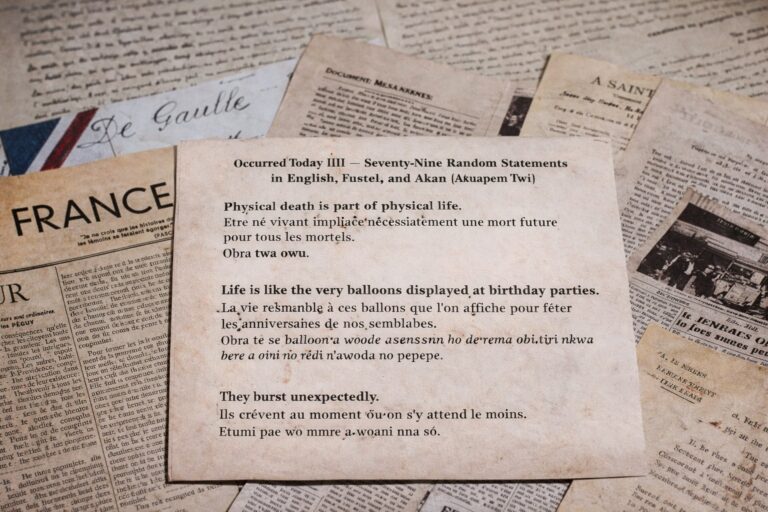
Occurred Today – The Sick Boy

English
It was quite early in the morning. Kwadwo Manu was only six years old, in class one. He could not go to school that morning because as soon as he woke up from bed, already looking pale and weak, he vomited, and could not eat breakfast.
His mother was angry, instead of being worried or concerned for her son. At the sight of the yellowish substance and the unpleasant odour coming from the mouth of the boy, she began yelling at him. Firstly, he was accused of falling sick at a time when there was almost no money at home to take him to hospital, about twenty kilometres from their quarters to the central part of the town. Only one truck conveyed people from the area they lived, very rural, to the town, and that put an extra stress on the mother who was burdened already by the thought of having to get the boy bathed, dressed and made ready for the roadside.
A little warm water was quickly prepared by Kwadwo Manu’s mother. The boy was cleaned up and dressed up with heavy doses of insults. Just for falling sick. The mosquito-infested environment did not come into the causes, arguments and accusations brought against the poor innocent child.
The distance between the exit door of Kwadwo Manu’s house and the roadside was about fifty metres but it took mother and son almost thirty minutes to cover the distance. At the first few steps, the boy fell down because he was shaking all over his body and could no more stand. He was forcibly lifted off the ground by his mother and dragged along in the dust like a piece of fallen wood, in an attempt to get him to walk. He managed to do so somehow, wobbling through a cleanly swept path bordered on each side by well-trimmed hibiscus hedges, gradually holding on to the shrubs with the frail infant resolve left in him.
Having finally reached the roadside, there was no hedge to grasp for support, so he sat almost in the middle of the dusty road, eyes sleepy, spoken words almost inaudible. The truck to carry them away to the hospital was finally approaching but he could not get up on his own. His mother was not prepared to lift him up, fed up with all the burdens of motherhood especially that of taking care of a child constantly sick of malaria.
“What are you waiting for in the dust?”, she shouted at the very top of her voice. “See how dirty you have made your clothes!”, she queried him, more concerned with the condition of his clothes than that the health of a dying child completely weakened by malaria. “Either you get up and come with me into the truck or I leave you behind!”, she thundered.
At that, Kwadwo Manu did not know where the strength for him to stand up suddenly came from. Up he went, and into the lorry, feeling somehow miraculously well all of a sudden, from the threatening statement made by his mother. It was not a sign of healing but a dangerous effect of the series of maltreatment he had received at the hands of his mother, not only that morning, but throughout his infancy. That strange sudden feeling of wellness came with something diffuse having gone instantly dead in his innermost being. It was some form of mental blockade, as if a thunderbolt had just jostled him out his sickly and deadly malaria sleep into some forced wakefulness. Not that something just sharply woke him up, something violently knocked him awake, temporarily sending him into a dark world, from the thundering threatening words of the very person expected to provide him with motherly care, love and security.
As he sat quietly by his mother on the wooden seat inside the packed and dark Bedford truck, he was completely unconscious of the human presence of her mother sitting close by him, she did not exist. Nor was he even aware there were other people in the vehicle about to move off to town. Unknown to him and his distraught mother, the malaria boy had just been knocked cold by psychological trauma or mental stress by her own words, an ailment not instantly visible to her naked eye. Yet, they were on a journey to seek treatment for another ailment whose symptoms she could easily detect through external observation.
Why give birth to a child when you cannot take good care of it? This is a simple question for all fathers and mothers in the world. Stop breeding monsters in the name of some outmoded cultural belief that barrenness is a curse, or in the name of some misinterpretation of a verse in the Book of Genesis in the Bible, that we must be fruitful, multiply, and replenish the earth. Not with deviants of all shapes and colours, which we manufacture ourselves, as parents.