
Searching for Meaning in Life and Language Part 5

Volume 1: Birthday Celebrations:
Part 5, Language and Translation Notes and Exercises
Please use the audio file below to follow along as we go through the texts, tackling this section to better guide you through the provided section for the notes and exercises.
INTRODUCTORY REMARKS
To maximise the merits of this printed book, it is advised that the reader makes use of it side by side with the audiobook version because natural human languages like English, French and Akan usually manifest themselves naturally in both spoken and written forms.
The four different orders in which the audio recordings are done is to ensure a balanced oral language proficiency in the three languages among Ghanaian students of French who have a firm grasp of the Akan language. The term Akan, not Twi, or Akuapem Twi, is used here based on the classification done in the seminal works of the pioneer German linguist Dietrich Westermann in many of his publications. Akan therefore goes far beyond Twi. Dietrich Westermann, the German scholar and linguist on several African languages, classified Akan into three different cluster dialects: (1) Twi-Fante, (2) Agni-Baoulé, and (3) Guan. In our workbook, we shall limit ourselves to Akuapem Twi.
The Revised Standard Version (RSV) With Deuterocanonical Books, published in 2008 by Bible Society Resources Ltd served as the source for the English Bible content in our text, that for the French was La Bible de Jérusalem, published in 1988 by Cerf. Excerpts in our Akan text were taken from The Akuapem Twi Bible titled Anyamesem Anaa Kyerew Kronkron Akan Kasa Mu, published in 1964 by the Bible Society of Ghana. Texts from Ecclesiastes and Revelation served as source texts of inspiration, just like numerous other standard Internet sources and meaningful pictures.
This work is primarily conceived and presented in what the author calls his own Ghanaian English, Ghanaian French and Akuapem Twi. He even believes his Akuapem Twi may have some strong Ghanaian English influences. If so many completely different varieties of French and English are officially recognised around the world outside what we hear and see in France and England, in accent, pronunciation and spelling, what prevents me from claiming mine for myself and one for my country Ghana without the slightest inferiority complex? Just take a trip to Canada (for French) and USA (for English), and you will see the point I am making here. These are linguistic scientific facts, not value judgements.
I am not referring to regional accents, which exist, even in France and England. So why strain yourself to imitate some accent in English and French? That accent you are forcing upon yourself may exist only in your mind and nowhere else, not in France, and not in England. I speak and write Ghanaian English and Ghanaian French, in vocabulary and syntax, and with a Ghanaian accent. This is obvious in the audiobook version of this very book you are reading. What matters is for you and your listener or reader around the world to understand you very clearly, in terms of what you actually intended or meant in what you have said or written.
The orthography of the Akan words which we have adopted here is unconventional, and it is not the official one, but it serves the author’s purpose very well. It may even be a contribution towards simplifying the Akan orthography and making it more suitable and practically realistic, linguistically, for modern computer keyboards, since many of the accepted traditional letters and symbols do not exist on most modern technological gadgets.
WORKBOOK
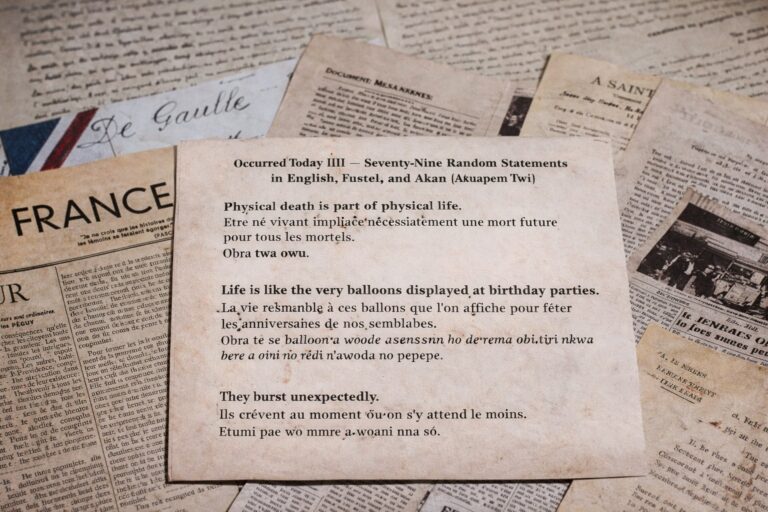
- Single out, read and listen to paragraph 5 in all the three languages.
- Anyansafo koma wo nkommodi fi, na nkwasea koma wo anigye fi.
- The heart of the wise is in the home of mourning, but the heart of fools is in the house of pleasure.
- Le coeur du sage est dans la maison du deuil, et le coeur des insensés, dans la maison de la joie.
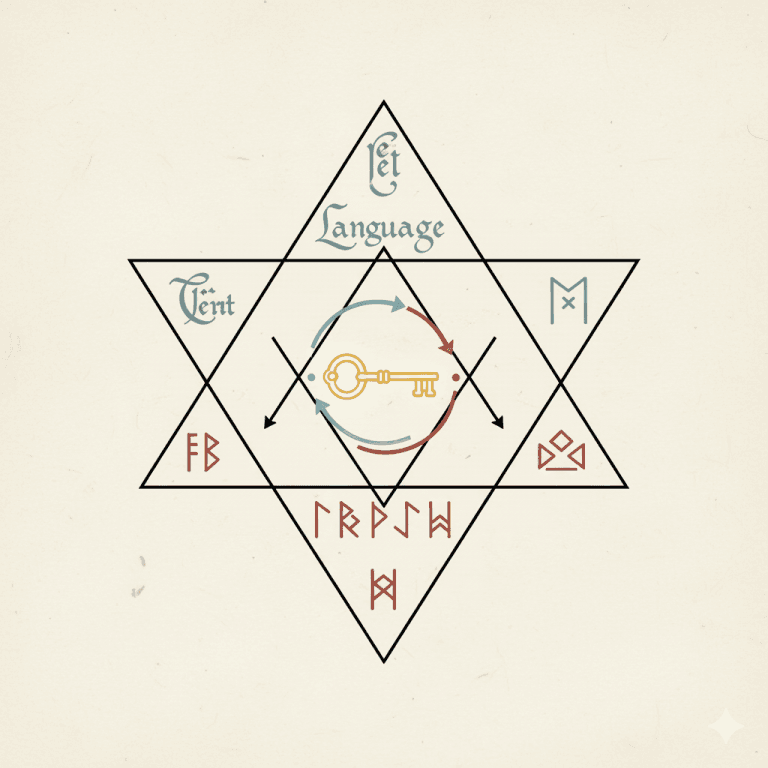
“Nkommodi”, which generally stands for chatting in Akan, finds itself outside that context; it is not the case of a hearty conversation here, but quite the opposite. ‘Nkommo’ in the Akan religious song “Gyae su gyae nkommo, mene wo nam; mene wo nam; Iehowa, mene wo nam afeboo” conveys the mental picture of what obtains in A3 in our equilateral triangles, as corresponding to A1 and A2 respectively in our English and French texts.
For your exercise, imagine and provide two different real-world contexts for a statement like: ‘One ne ba no redi nkommo resrew deneenen wo adiwo ho.’ Take each word in the statement, at level A3 of Triangle 3, and determine how each of them, especially ‘nkommo’, will feature at levels A1 and 2 on the English and French equilateral triangles, if you were to bring the two statements into English and French. The focus is not on the dictionary meaning of ‘nkommo’ but what you visualise as occurring on the mind of the speaker or writer, as the word ‘nkommo’ comes into his mind in the statement.
- Let us now go through paragraph 6 in all the three languages, listening and reading at the same time. Why is “Osenkafo Nkoma no ti ason nkyekyem a edi kan kosi ason” appearing in written form as an equivalent on the mind of the translator, for “one of the books in a worldwide highly respected library, simply called The Book”, in English; and “l’un des livres de la bibliothèque du Livre”, in French?
- We will concentrate, next, on the three audio permutations of paragraph 8. Ensure you have attempted to look simultaneously at the written forms in the three languages while listening to the audiobook. “Kyerew Kronkron” and “Adiyisem ofa a eto so 14 nkyekyem 13” do not appear immediately to correspond in any way, in spoken and written form, to “the last library book of the Book”, in English; nor to “le dernier livre du Grand Livre”, in French. Why?
In making use of our equation on interpretation and in applying the mathematical and linguistic principle of the three equilateral triangles presented here, why do you think the translator had those two Akan portions on his mind, in relation to the English and French words seen in the text and heard in the audiobook?
- Finally, we hear and also see written in Akan “fi nonsia kosi nonsia bio” in paragraph 9. The original statement in the author’s mind occurred in English as “24 hours in a day” and then it came to “24 heures sur 24” in French, before ending in the Akan expression “fi nonsia kosi nonsia bio”. We need to ask ourselves whether it could not have been something like ‘donhwerew 24 da koro’ and what that would have meant, if it has any meaning at all in Akuapem Twi.
Memorising the words, phrases and sentences in language learning rather poses stumbling blocks to naturalness in speaking and writing the language later, it simply hampers fluency. The absence of live and naturally occurring fast mental pictures in expressing oneself orally or in the written form leads to two kinds of dumbness: uncomfortable total silence, where no word is uttered or written down, or else a meaningless combination of spoken and written words. Conversely, not being able to discover the exact mental picture behind a word which was spoken or written by another person in the past leads to ascribing a thousand and one false interpretations or caricatures to that one and single mental picture of the person. The essence of a word in a personal statement lies in the bosom of the speaker or writer.
Listen continuously to your audiobook and do not forget to do so while looking, at the same time, at how the words you hear are written. Do not forget that it is all about Ghanaian English, Ghanaian French and Akuapem Twi with English influences.
- The English text was the original text. What it means is that every word, punctuation mark and paragraphing space in the English text represented something specific in the mind of the author as his thoughts and second reflections were systematically unfolding in real time and real space. ‘Time’ here refers to the very seconds taken up by each word getting imprinted on the rough paper he was using to physically jot down the words in English. ‘Space’ in our statement here refers to the physical space occupied by each word on the physical paper of the jotter, and eventually, the space each word occupies on the computer screen. The word processor of the computer is able to indicate the number of words in the entire English text and where precisely the word can be found, in terms of which paragraph and which line.
For your exercise, look out for the 10 spaces of the 10 instances when the word “that” emerges from the mind of the author and settles inside the English text. In each instance, what was specifically on the author’s mind, as the essence of the symbol A1? Does each of the 10 separated thoughts around the word “that’ correspond somehow to what you may locate as the A2 and A3 respectively in the French and Akan texts? Finally, do the same exercise around the word “wise” in the English text. You will see the word “wise” in only 3 spaces in the English text. What do you think was A1 in the mind of the author as represented in written form by the word “wise”?
Do you realise that this exercise can be done for each and every single word in the English text? That is the inquiry towards what we have termed UnitFpsy (unit psychological function) in our Interpretation Equation, in searching for what the word must represent in the mind of the writer. At the level of more than a word, in the case of a sentence for instance, we are interested in the AggFpsy (aggregate psychological function) of the words in the mind of author at a particular point in real-life history. Therefore, the two cannot fully be determined unless we have sufficient and reliable indices on the FHB (full historical background) of the event of the writing, the episode of the genesis and the actual production of the text, from the mind of the particular human being who wrote what has been written down. That same author may have written other texts before, with consistent recurring patterns of a distinctive psychological nature, singling him out from all other writers in the world like his finger print, his linguistic identity card. That human identification procedure is established from a continuum, which we have named CIMP-CPMP (continuum d’images mentales personnelles or continuum of personal mental pictures) in our Interpretation Equation.
So you see that in following this path of linguistic analysis of the words and sentences in the English text, we are more inclined towards discovering the personality or nature of the writer and not just a memorisation of dictionary meanings of words to be mechanically reproduced, or ‘used’, as we often say, for forming artificial sentences which are grammatically correct but have no connection to human beings or the natural world. Again, our practical analytic method enables us to determine the As of the 3 equilateral triangles in translation, the original and equivalent mental pictures, so that we are not swayed by the possible caricatures which are all too often the outcome of relying robotically on the spoken or sound forms in the Bs of the triangles, and on the visual or written forms in the Cs of our triangles.